The Early Days: Programs Without Operating Systems
In the earliest days of computing, everything was slow, physical, and deeply manual. There were no keyboards, no screens, and certainly no operating systems. Computers were rare, mechanical giants that filled entire rooms.
1833–1871: Charles Babbage works on the Analytical Engine (first described 1837), laying the foundation for mechanical computing, though it was never completed.
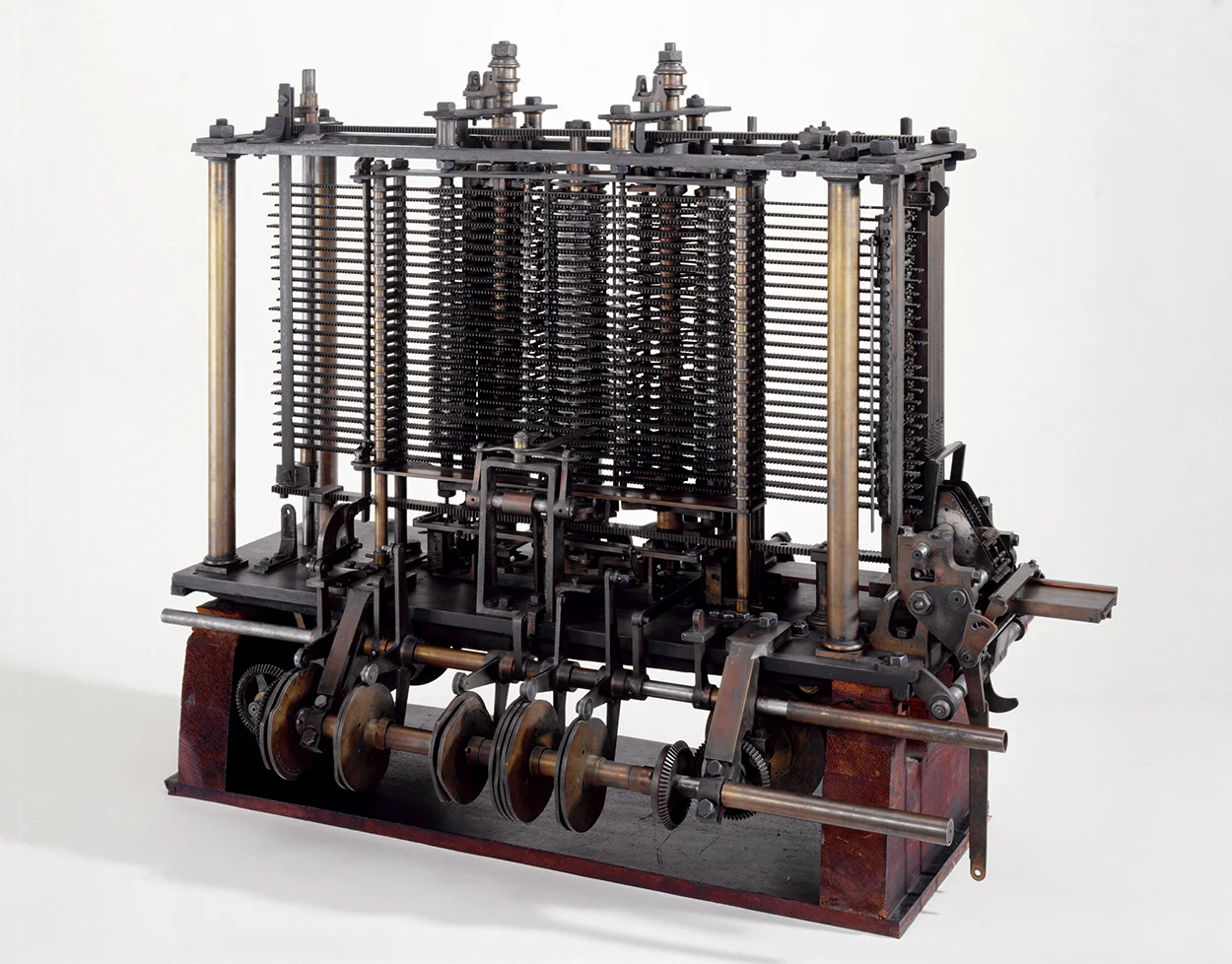
The Analytical Engine: Early computers were massive, mechanical, and operated by teams of people.
Punch Cards: When Programs Were Paper
Programs were written on punch cards—stiff pieces of paper with rows and columns. Each card held a single line of instructions. Holes punched in specific positions represented binary data: a hole meant 1, no hole meant 0. These cards were fed into a punch-card reader, which used light to detect holes and translate them into machine instructions.
1940s–early 1950s: ENIAC (completed 1945, unveiled 1946) and early mainframes like UNIVAC (1951) and IBM 701 (1952) were programmed manually, with no operating systems.
1950s–1960s: Punch cards dominate program and data input in many installations, though the technology itself predates this era.
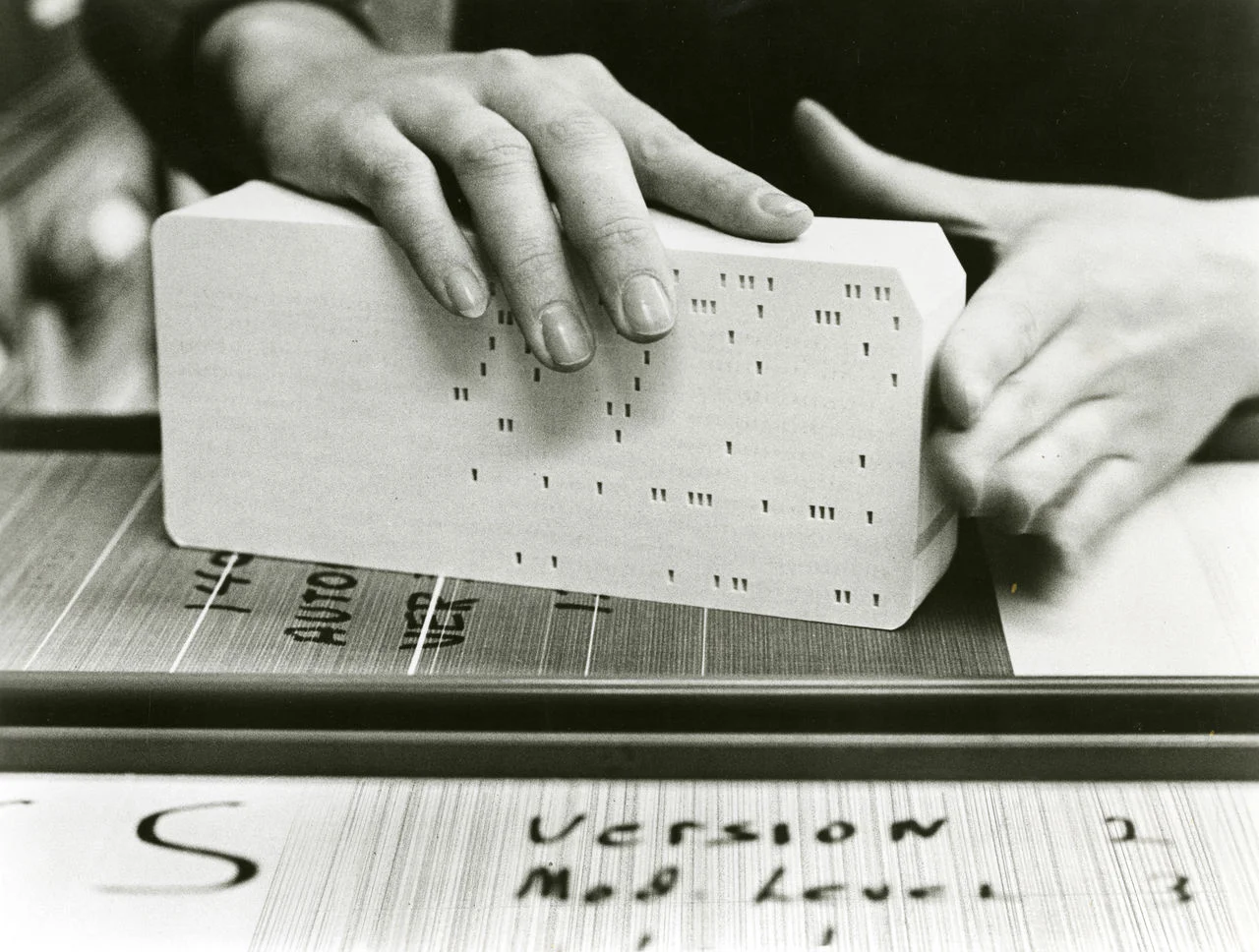
Punch cards: Each card encoded a line of code. Stacks of cards made up entire programs.
A program wasn’t a file; it was a stack of cards. Once the computer read the instructions, it executed them and produced output—either as printed paper or another stack of punch cards containing the results.
The Human Operator: The First Operating System
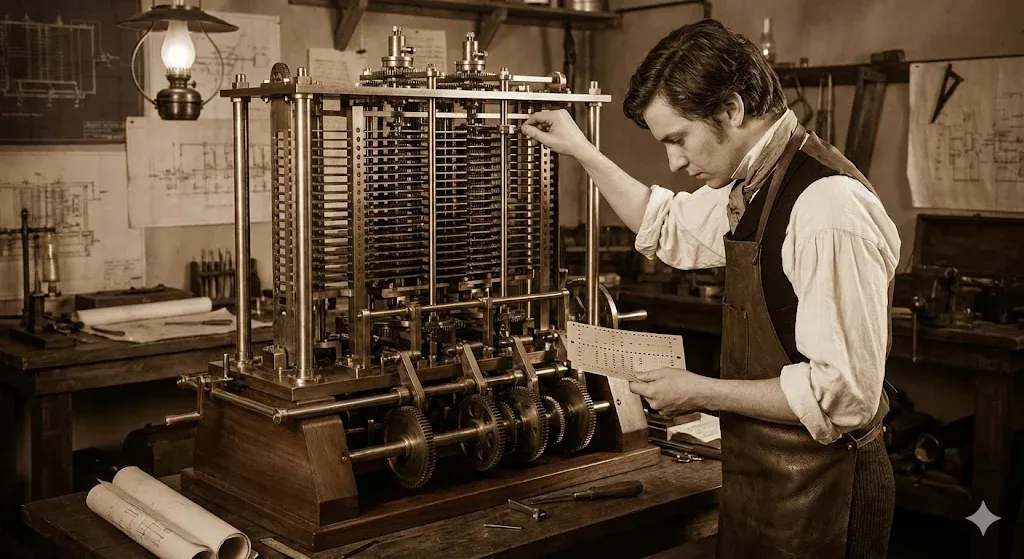
A human operator manually manages the computer, feeding punch cards and configuring the machine—an essential role before the advent of true operating systems.
This entire process was managed by a human operator. The operator collected punch cards from programmers, fed them into the computer, configured switches and cables, started execution, collected the output, and returned results to the programmers. The operator was the gatekeeper of the machine.
1956–late 1950s: Batch processing emerges—monitor systems like GM-NAA I/O (1956) automate job sequencing, reducing the need for manual operator intervention.
If several programmers wanted to run their code, they had to wait for hours. A program might run successfully in seconds, or fail instantly due to a single misplaced hole. If it failed, the operator stopped the machine, returned the cards, and the programmer had to fix the error and rejoin the queue.
Can we automate the process of human operator?
As computers became more popular, more and more people wanted to use the same machine—but the process hadn’t changed. Programmers were still standing in line, operators were still feeding punch cards by hand, and everyone was still waiting.
At some point, a simple but powerful question naturally came up:
“Why does a human have to decide which program runs next? Can’t the computer do that by itself?”
That question changed everything. It led to the development of batch processing, job queues, and eventually the operating system.
1961–late 1960s: Time-sharing and multiprogramming arrive. CTSS is demonstrated in 1961, Multics begins in 1965, and UNIX starts in 1969—ushering in interactive computing and modern OS concepts.
The Solution: Let Software Do the Work
Engineers created the Operating System (OS)—a software system designed to replace the human operator. Its job was to automatically manage program execution, schedule jobs, reduce human error, and keep the machine busy.
The Boss of the Computer: The Operating System
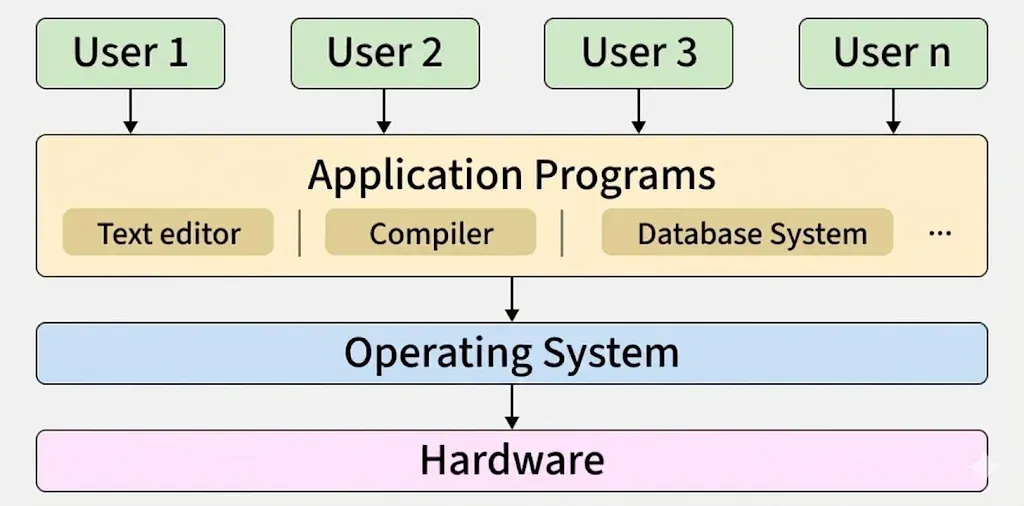
The operating system acts as a bridge between users, application programs, and the computer hardware, managing resources and enabling multitasking.
The operating system is simply a compiled program stored on the computer’s disk. When you turn on your computer, the very first program that loads into RAM is the operating system. This startup process is called booting.
Once loaded, the OS:
- Takes control of the CPU
- Manages memory (RAM)
- Controls hardware devices (disk, keyboard, mouse, network)
- Manages all other software
From this moment onward, nothing runs on the computer without the OS’s permission. That’s why the operating system is often called the boss or manager of the computer.
Even though operating systems look different on the outside—such as macOS, Linux, and Windows—their core responsibilities are largely the same.
1970s: UNIX is rewritten in C (by 1973), making it portable and widely adopted.
1981–1980s: The personal computer OS era begins—MS-DOS (1981), Macintosh System 1 (1984).
1990s: Windows, Linux, and classic Mac OS mature; Linux kernel is first released in 1991.
2006–Present: Cloud, mobile, and containers reshape the OS landscape—AWS launches in 2006, iPhone in 2007, Android 1.0 in 2008, Docker in 2013.