Process States and Transitions
A process state represents the current condition of a process in the operating system. During its lifetime, a process transitions through several well-defined states. Understanding these states is crucial for grasping how the OS manages processes.
The 5 Process States
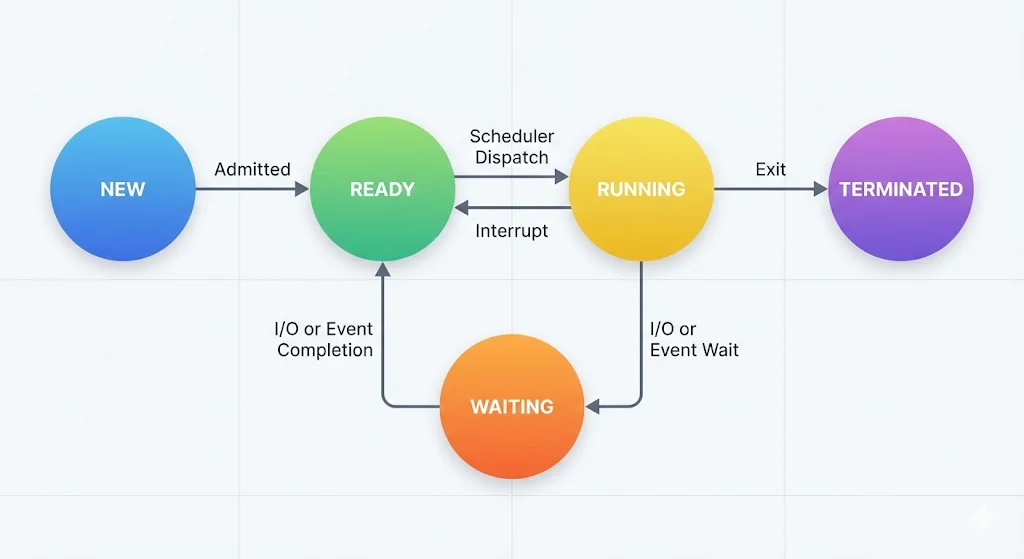
Process transitions through 5 states: New → Ready → Running ↔ Waiting → Terminated
State 1: NEW
Process is being created by os in Disk (PCB allocated, not in RAM yet).
When: Right after fork() (Unix) or CreateProcess() (Windows) system call.
What happens:
- OS allocates a PCB
- Process code is loaded from disk
- Memory is allocated but process is NOT in RAM yet
- Process hasn’t started executing
Example:
pid_t pid = fork(); // ← Process P1 is in NEW state hereNext State: Ready (when loaded into RAM)
State 2: READY
Loaded in RAM, waiting in the “Ready Queue” for the CPU.
When: After loaded into memory, but scheduler hasn’t allocated CPU yet
What happens:
- Process is loaded in RAM
- All resources are allocated
- Process is waiting in the “Ready Queue”
- Many processes can be in READY state simultaneously
- Scheduler will pick one based on priority
Example:
Ready Queue: [P1] [P2] [P3] [P4]
               ↑
            Next to run?
Next State: Running (when scheduler allocates CPU)
State 3: RUNNING
Currently executing instructions on the CPU.
When: Scheduler has allocated CPU time to this process
What happens:
- Process instructions are executing
- CPU registers contain process’s data
- Program Counter points to current instruction
- Only ONE process can be in RUNNING state at a time (on single-core CPU)
Example:
printf("I'm running!\n");  // ← This line is executing NOW
// This process is in RUNNING stateDuration: Limited by time quantum (typically 10-100 milliseconds)
Next State(s):
- Ready: Time quantum expires (context switch)
- Waiting: Process calls I/O or blocking operation
- Terminated: Process calls
exit()
State 4: WAITING (Blocked)
Paused, waiting for an event (I/O, Mutex).
When: Process needs something it doesn’t have (I/O, lock, etc.)
What happens:
- Process can’t continue without the event
- CPU is released for other processes to use
- Process is moved to “Wait Queue” for that specific resource
- Process will remain blocked until event occurs
Common reasons for WAITING:
// Scenario 1: Waiting for file I/O
read(fd, buffer, 100);  // ← Blocks until data is read from disk

// Scenario 2: Waiting for user input
scanf("%d", &x);        // ← Blocks until user types

// Scenario 3: Waiting for a lock
pthread_mutex_lock(&lock);  // ← Blocks until lock is available

// Scenario 4: Waiting for network I/O
recv(socket, buffer, 100);  // ← Blocks until data arrives

// Scenario 5: Sleeping for a duration
sleep(5);               // ← Blocks for 5 seconds

// Scenario 6: Waiting for child process
wait(&status);          // ← Blocks until child exits
Example flow:
Process executes:
  read(disk_fd, buffer, 1024);

  ↓

Disk is slow, process can not continue

  ↓

Process moves to WAITING state
CPU scheduler picks another READY process
Disk reads data...

  ↓

Data is ready, interrupt occurs
Process moves from WAITING → READY
Waits for CPU again...
Next State: Ready
State 5: TERMINATED
Process execution has finished
When: Process calls exit() or is killed
What happens:
- Process stops executing
- OS performs cleanup:
- Closes file descriptors
- Deallocates memory
- Terminates child processes (if any)
- Notifies parent process of exit status
- PCB may remain briefly (for parent to read exit status)
- Eventually removed from process table
Normal Termination:
int main() {
    printf("Doing work...\n");
    return 0;          // ← Process terminates normally
}
Abnormal Termination:
kill -9 <PID> # ← OS forcefully terminates processNext State: (removed from system)
State Transitions in Detail
1. NEW → READY
Trigger: OS loads process into RAM
When fork() completes:
  ├─ PCB created
  ├─ Memory allocated
  ├─ Process image loaded
  └─ Process moves to READY
2. READY → RUNNING
Trigger: Scheduler allocates CPU time
// Multiple processes waiting:
Ready Queue: [P1] [P2] [P3] [P4]

Scheduler decision:
  if (P1.priority > P2.priority) {
    P1 → RUNNING
  }

// Now P1 executes while others wait
3. RUNNING → READY
Trigger: Time quantum expires or higher priority process arrives
Time Quantum Expired:
RUNNING P1 (10ms used)
  ↓
Scheduler timer interrupt
  ↓
Save P1 state to PCB
  ↓
P1 → READY (back to queue)
  ↓
Load P2 from READY
  ↓
P2 → RUNNING
4. RUNNING → WAITING
Trigger: Process executes blocking operation
// Process is executing...
RUNNING:
  read(fd, buffer, 100);  // ← Can't continue without data!

  ↓

OS detects blocking operation
  ↓
Save state to PCB
  ↓
Move process to WAITING
  ↓
Scheduler picks another READY process
  ↓
Data arrives (interrupt)
  ↓
Process → READY (waits for CPU again)
5. WAITING → READY
Trigger: The waited-for event occurs
Waiting for disk read:
  read() call waiting...

  ↓ [Disk controller finishes reading]

Disk I/O interrupt occurs
  ↓
OS wakes up process
  ↓
Process → READY queue

Now it waits for CPU again (not for disk anymore)
6. RUNNING → TERMINATED
Trigger: Process calls exit() or receives SIGKILL
// Normal termination
RUNNING:
  printf("Done!\n");
  return 0;  // ← exit(0) called

  ↓

OS cleanup:
  ├─ Close files
  ├─ Free memory
  ├─ Notify parent
  └─ Remove from table
Example: Web Server
Multiple client connections:

Client 1        Client 2        Client 3
   │               │               │
   ├──→ P1         ├──→ P2         ├──→ P3
   │               │               │


Timeline:

T=0ms:  P1 RUNNING (processing request)
        P2 READY (waiting for CPU)
        P3 READY (waiting for CPU)

T=5ms:  P1 hits I/O (reads from disk)
        P1 → WAITING
        P2 → RUNNING (scheduler picks next)

T=10ms: P2 finishes quickly, calls exit()
        P2 → TERMINATED
        P3 → RUNNING

T=15ms: P1 disk read completes
        P1 → READY
        P3 still RUNNING

T=20ms: P3 time quantum expires
        P3 → READY
        P1 → RUNNING (back with data)